
Researchers Develop Low-Cost 3D-Printed Robotic Arm with High Success Rate
Written with artificial intelligence.
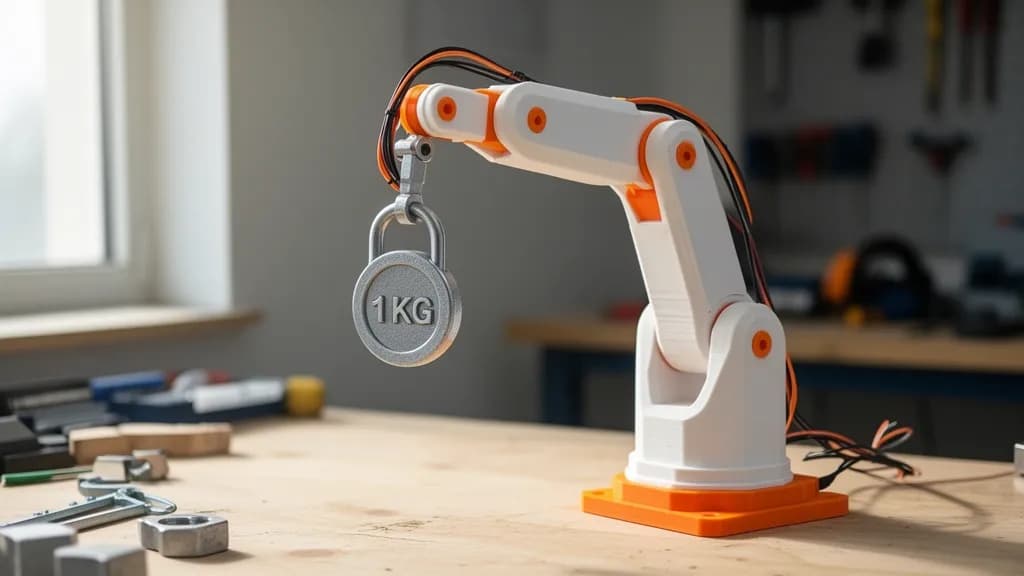
A team of researchers has successfully developed a low-cost robotic arm, named the Smart Powered Lifting Robotic Arm (SPLRA), capable of lifting a 0.8 kg payload in all ten trials conducted. This arm demonstrates a repeatability of 2.47 mm and offers a comprehensive framework for affordable robotic manipulation.
Overview of the SPLRA
Researchers have designed a low-cost robotic arm known as the Smart Powered Lifting Robotic Arm (SPLRA), which is primarily composed of 3D-printed parts, standard stepper motors, and an Arduino controller. It successfully lifted a 0.8 kg payload in ten laboratory trials without any failures, including dropped loads or motor stalls.
Design and Testing
The SPLRA was created to address a gap in the low-cost robotics literature, where many projects fail to provide quantitative payload testing and structural verification. The design process utilized SolidWorks for mechanical design, fused deposition modeling for printing components in PLA and PETG, and NEMA 17 stepper motors with a gear transmission system. Control is managed by an Arduino microcontroller and can be operated via a mobile application.
Performance Metrics
The arm achieved a 100% success rate in lifting the specified payload during trials, with positional repeatability of 2.47 mm and an average lift cycle time of 3.33 seconds. The design incorporates a safety factor of 2.0 for both actuator sizing and structural verification, ensuring that the arm can operate effectively under the tested conditions. The performance varied with lifting angles, showing that the arm completed lifts faster at steeper angles due to reduced resistance.
Practical Considerations
Electrical validation confirmed that a 12-volt, 2-ampere supply could power the motors without overload, as the motors were activated sequentially. While the arm has shown short-term mechanical stability, the authors caution that long-term durability and fatigue life remain untested. This prototype serves as a teaching tool rather than an industrial robot, adhering to safety standards to limit payload and operational speeds.