
3D Printed Implant Offers New Hope for Drug-Resistant Epilepsy
Written with artificial intelligence.
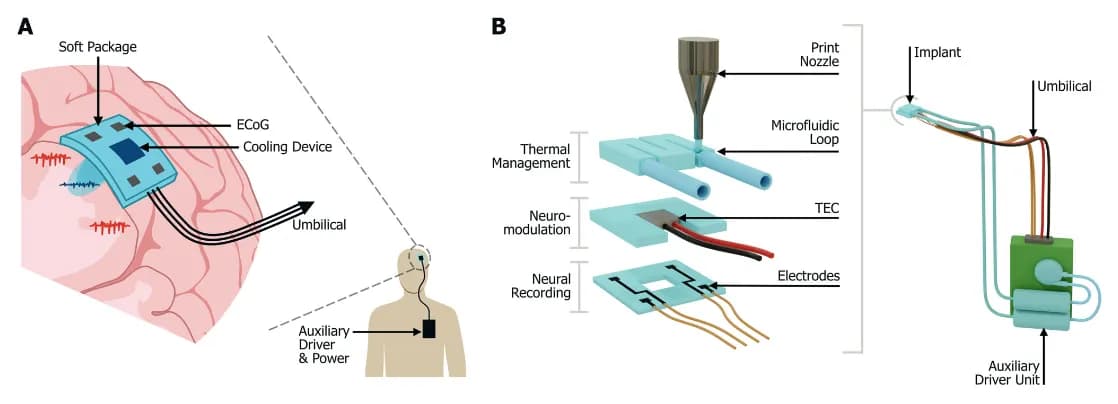
Researchers have developed a 3D printed silicone implant that can cool specific areas of the brain while monitoring electrical activity, showing promise in reducing seizure-like behavior in rats. The device combines cooling, heat removal, and recording functions into a single soft implant, which could pave the way for new treatments for drug-resistant epilepsy.
Innovative Brain Cooling Implant
A collaboration between researchers from the Leibniz Institute for Polymer Research Dresden, TUD Dresden University of Technology, the University of Sheffield, and the University of Limerick has led to the creation of a groundbreaking 3D printed silicone implant. This device cools targeted areas of the brain while simultaneously recording its electrical activity, offering potential as a treatment for drug-resistant epilepsy.
How It Works
The implant utilizes focal brain cooling, which temporarily lowers the temperature of a specific brain region to reduce neural activity, thus providing a reversible method to mitigate seizures. The design overcomes previous challenges posed by bulky hardware, which was ill-suited for the delicate environment of the brain.
The device is constructed using direct ink writing (DIW) with Dow's DOWSIL SE1700 silicone, creating a compact implant measuring 10 x 10 x 3 mm. It comprises three layers: electrodes made from a graphite-silicone composite, a miniature thermoelectric cooler (TEC), and a water channel for heat transfer. An external driver unit regulates the system and ensures the surrounding brain tissue does not exceed a 1°C increase in temperature.
Experimental Results
In trials with nine anesthetized rats, the implant demonstrated its ability to suppress seizure-like activity induced by 4-aminopyridine. Cooling sessions at varying temperatures effectively reduced brain signal energy, with the device achieving significant cooling within seconds. However, further studies are necessary to understand the varying efficacy at lower temperatures.
Future Development and Challenges
Although the cooling depth of 1 to 3 mm aligns well with the human neocortex's thickness, clinical applications will require improvements, including miniaturizing the external driver unit and ensuring reliable power sources. The researchers also suggest future adaptations could enable the device to automatically adjust cooling based on real-time brain activity. This study, published in the journal Advanced Science, represents a significant step in the evolution of multi-functional brain implants, integrating temperature control and electrical monitoring in a single device.