
Innovative 3D Printed Implant Offers Hope for Drug-Resistant Epilepsy Treatment
Written with artificial intelligence.
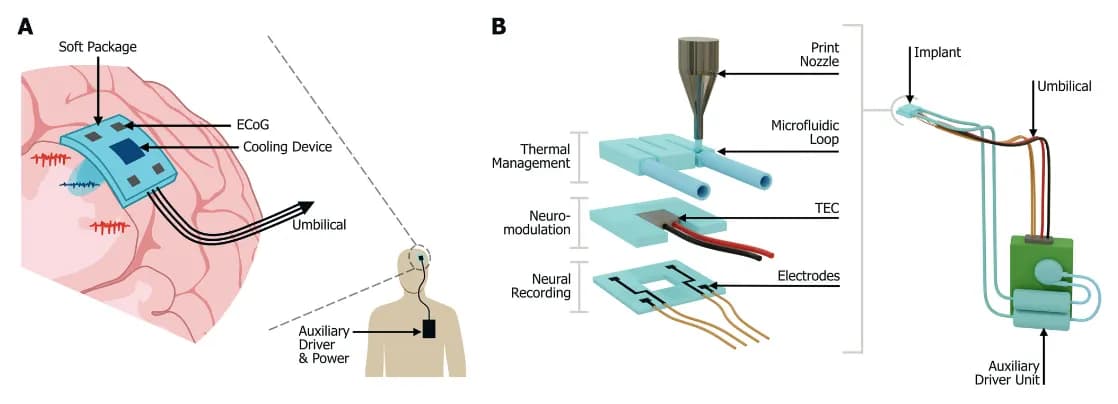
A collaborative research team has developed a 3D printed silicone implant designed to cool specific areas of the brain while monitoring electrical activity. This device has shown promise in suppressing seizure-like activity in rats, potentially providing a new treatment avenue for those with drug-resistant epilepsy.
Overview of the Implant
Researchers from the Leibniz Institute for Polymer Research Dresden, TUD Dresden University of Technology, the University of Sheffield, and the University of Limerick have created a 3D printed implant that cools targeted areas of the brain's surface while recording its electrical activity. In experiments with rats, the implant significantly reduced seizure-like activity, indicating its potential as an alternative treatment for drug-resistant epilepsy.
Technical Details
The implant, measuring 10 x 10 x 3 mm, was fabricated using direct ink writing (DIW) with Dow's DOWSIL SE1700 silicone on a RegenHU 3D Discovery printer. It consists of three layers: the bottom layer with electrodes made from a graphite-silicone composite, the middle layer housing a thermoelectric cooler (TEC) to manage heat, and the top layer containing a water channel for heat removal. The design is aimed at maintaining safe temperature levels in surrounding brain tissue during use.
Experimental Results
In trials with nine anesthetized rats, seizure-like activity was induced using the drug 4-aminopyridine. The implant applied cooling events ranging from 25°C to 15°C, which successfully reduced brain signal energy across all temperatures tested. Notably, the most significant reductions occurred in the delta and beta brainwave bands, although activity returned after cooling ceased, indicating the treatment alleviated but did not terminate seizures.
Challenges Ahead
While the current design targets a cooling depth similar to that of the human neocortex, challenges remain for clinical application, including miniaturizing the external driver unit and ensuring reliable power supply and connectivity. The researchers suggest pursuing wireless power transfer and integrating automatic cooling triggers based on recorded brain signals, similar to adaptive deep brain stimulation techniques used in Parkinson’s disease treatment. This work was partially funded by the European Research Council and highlights a significant step toward multi-functional brain implants.
Conclusion
The development of this 3D printed brain cooling implant represents a promising advancement in the treatment of drug-resistant epilepsy. As the research progresses, it may pave the way for more effective and integrated solutions for managing seizures in patients who do not respond to traditional medications.