
Microgravity Research Aims to Improve Metal 3D Printing
Written with artificial intelligence.
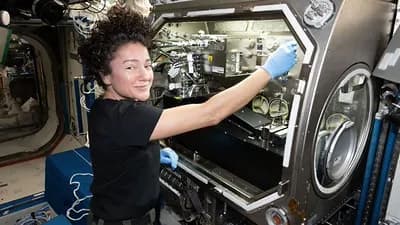
The U.S. National Science Foundation and the ISS National Laboratory have launched a research project to study metal powder melting in microgravity, led by Patricia Weisensee from Washington University in St. Louis. This investigation seeks to enhance models for particle melting, potentially reducing defects in metal 3D printed parts.
Research Objectives
The U.S. National Science Foundation (NSF) and the International Space Station (ISS) National Laboratory have initiated a project focusing on the melting and mixing of metal powder particles, crucial for metal 3D printing. The research, spearheaded by Patricia Weisensee from Washington University in St. Louis, aims to develop more accurate models that can help minimize defects in additively manufactured metal components.
The Challenge of Studying Melting on Earth
Understanding how metal powder particles melt and blend is essential to producing strong and uniform materials. However, gravity complicates this observation, as buoyancy-driven fluid flows can mask the effects of surface tension, which is significant at the scale of individual particles. Weisensee's project, titled “Beyond Buoyancy: The Role of Non-Gravitational Transport Phenomena on the Melting Dynamics of Small Particles,” will utilize the microgravity environment of the ISS to isolate these effects, allowing for better measurements of how various forces influence melting and mixing dynamics.
Broader Applications
The findings from this project could extend beyond 3D printing, impacting areas like drug delivery and microplastic recycling, where understanding particle behavior in liquids is vital. Additionally, the second project announced, led by Chen Li from the University of South Carolina, will examine flow boiling in cooling systems, which is relevant for electronics and thermal management technologies.
A Decade of Microgravity Research Impact
Since its inception over a decade ago, the partnership between NSF and the ISS National Lab has funded nearly 100 projects across various fields, producing more than 350 peer-reviewed publications. The insights gained from these experiments are expected to drive innovations in multiple technological domains, emphasizing the value of microgravity research for foundational scientific questions.