
Industrial 3D Printer Revenue Rises by 40% Amid Desktop Market Saturation
Written with artificial intelligence.
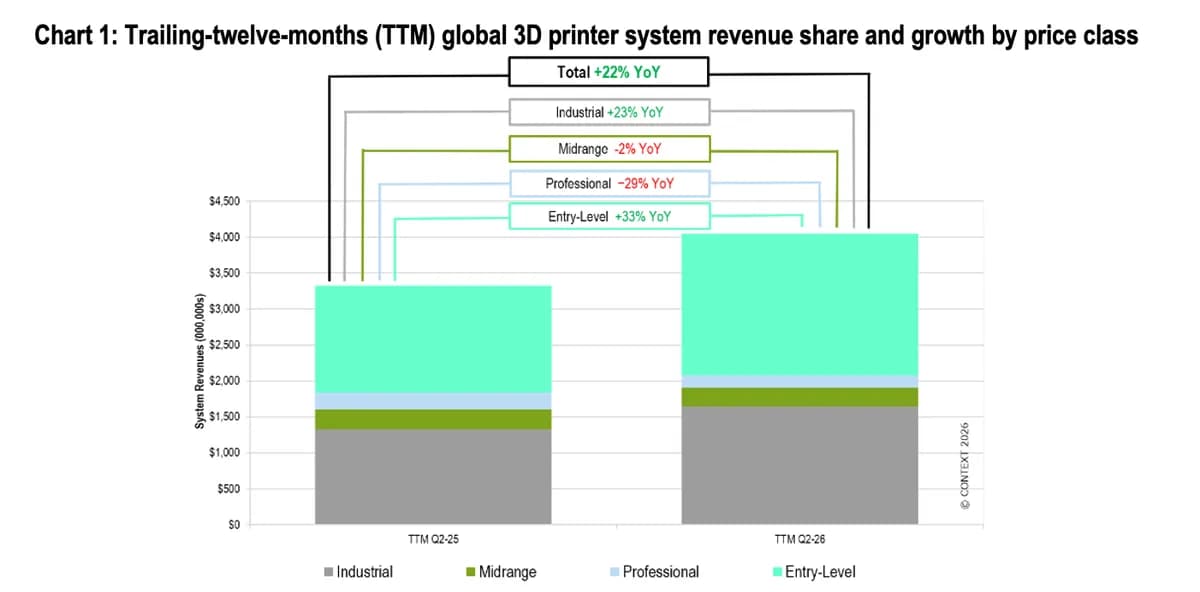
In the second quarter of 2026, global revenues for industrial 3D printers surged by 40% year-on-year, driven by demand in aerospace, defense, and consumer electronics. Meanwhile, the entry-level printer market continues to dominate hardware revenue, indicating a possible saturation in the desktop segment.
Growth in Industrial 3D Printing
According to recent data from CONTEXT, global hardware revenues for 3D printers grew by 31% year-on-year in Q2 2026, marking a notable recovery in the additive manufacturing market. The industrial sector, particularly, saw a 40% increase in revenue, underscoring its growing importance in the production of advanced technologies such as drones, rockets, and mobile devices.
Entry-Level Printers Lead the Market
Entry-level printers, priced under $2,500, accounted for 49% of total hardware revenue over the past twelve months, surpassing industrial systems which contributed 41%. In Q2 alone, the revenue from entry-level devices rose by 36% year-on-year. The dominance of entry-level models, primarily driven by manufacturers in China, raises concerns about potential market saturation.

Metal Systems and Regional Trends
Industrial printers, which are valued above $100,000, experienced a 25% increase in unit shipments. Notably, metal additive manufacturing systems constituted 53% of industrial shipments and 75% of revenue, highlighting strong demand in the aerospace and defense sectors. China led the market with 37% of industrial shipments, followed by North America and Western Europe.
Challenges and Future Outlook
Despite the robust growth, there are signs of an oversupply in the entry-level market, as indicated by Creality’s recent profit warning. As competition intensifies and companies like Bambu Lab expand into other technologies, the sustainability of growth in the 3D printer market remains uncertain. CONTEXT's findings suggest that while demand is strong, the ability of the market to absorb the influx of new units is questionable, particularly as the holiday season approaches.