
Advancements in 3D Printed Hydrogels for Soft Robotics
Written with artificial intelligence.
Researchers from Shanghai Jiao Tong University have developed a novel treatment for 3D printed hydrogels that enhances their stretchability to 1100%, making them suitable for soft robotics applications. This innovation allows for the creation of complex actuators and robots capable of delicate movements in confined spaces.
Introduction
Soft robots are designed to navigate delicate environments, requiring materials that are not only soft but also highly deformable and capable of being printed into intricate internal shapes. Traditional DLP 3D printing techniques, however, often result in hydrogels that are too stiff and limited in stretchability, hindering their effectiveness in soft robotics.
Innovative Hydrogel Treatment
A team at Shanghai Jiao Tong University has introduced a post-printing treatment that modifies the internal structure of 3D printed hydrogels, significantly enhancing their stretch potential. This research, published in Nature Communications, demonstrated the application of this hydrogel in inflatable actuators and robotic designs that exhibit walking and crawling capabilities.
Mechanism of Improvement
The researchers developed a printing ink that utilizes poly(vinyl alcohol) modified with o-nitrobenzyl acetal groups, along with methacrylated hyaluronic acid as a crosslinker. This approach separates the initial shape fixation from subsequent mechanical tuning. Key enhancements include:
- Hydrophobic Treatment: This step involves attaching water-repelling side chains, which improves tensile strength and facilitates stretching.
- Alkaline Cleavage: Following the hydrophobic treatment, ester crosslinks are cleaved to lengthen effective chains, allowing for greater flexibility and stretchability.
The treated hydrogels achieved a tensile strength of 6.3 MPa and an impressive 1100% strain, far surpassing untreated prints. This enables the materials to maintain structural integrity through multiple loading cycles.
Applications in Soft Robotics
Utilizing the treated hydrogel, the researchers successfully printed a range of actuators capable of significant expansion, a crucial feature for applications such as gripping and movement. Notable outcomes include:
- A petal-shaped actuator that can lift loads between 25 to 40 grams.
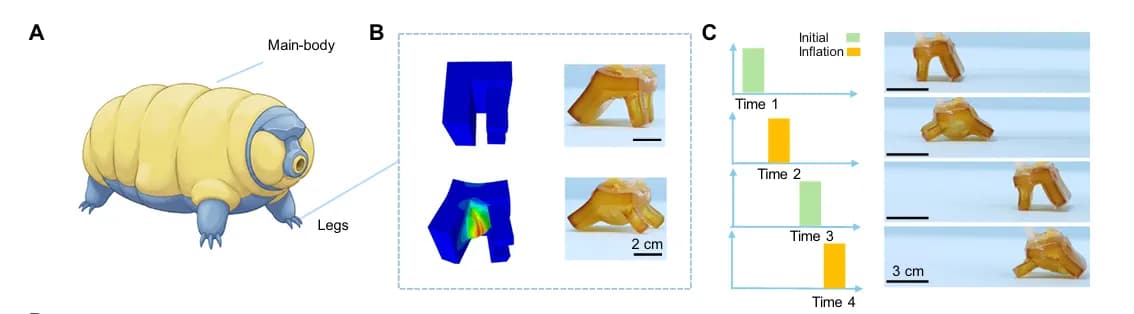
- A four-legged robot inspired by the tardigrade, which demonstrated effective locomotion using inflatable legs.
- A worm-like robot capable of navigating through confined spaces while carrying payloads.
This development not only enhances the functionality of soft robots but also opens avenues for minimally invasive medical applications, such as vascular navigation, showcasing the potential impact of advanced hydrogel materials in robotics and beyond.