
Local Production of 3D Printed Ceramic Lift Pins Enhances Semiconductor Operations in Singapore
Written with artificial intelligence.
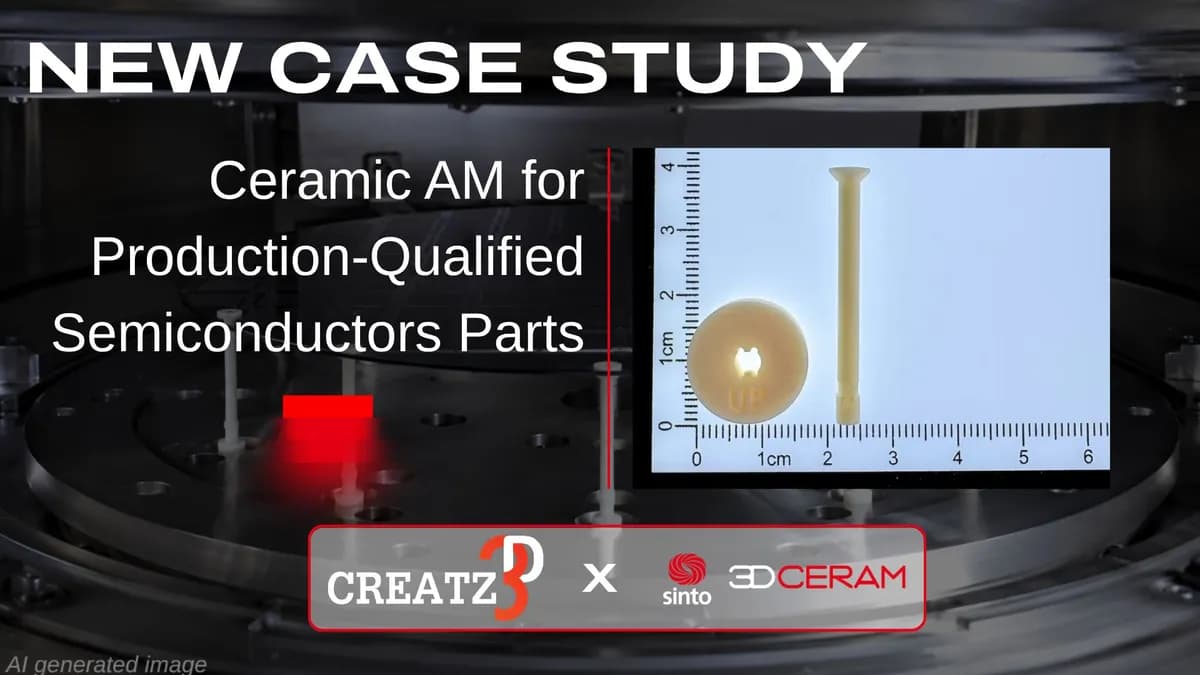
Creatz3D, a Singaporean additive manufacturing firm, has successfully delivered 600 sets of locally produced alumina lift pins to a major semiconductor foundry. This achievement marks a significant reduction in supply lead times and demonstrates the potential of ceramic additive manufacturing technology in critical semiconductor applications.
Local Manufacturing Breakthrough
Creatz3D, an additive manufacturing specialist based in Singapore, has recently delivered 600 sets of 3D printed alumina lift pins to a leading global semiconductor foundry. Notably, these components have achieved full production qualification for use in chemical vapor deposition (CVD) chambers, highlighting the advancements in local manufacturing capabilities.
Production Details
The lift pins, which measure approximately 6.5 mm in diameter and 40 mm in height, were produced using ceramic additive manufacturing technology from 3DCERAM SINTO. The entire production cycle, including printing, debinding, sintering, and post-processing, was completed in just six weeks. This rapid turnaround significantly shortens the supply chain, allowing the foundry to maintain uninterrupted production and reduce reliance on overseas suppliers.
Benefits of Local Production
The collaboration between Creatz3D and the semiconductor foundry provides several advantages:
- Supply Chain Resilience: Local production minimizes dependency on international sources.
- Shorter Lead Times: Transitioning from design to qualified production occurs within weeks.
- Cost Efficiency: Reduces total costs for complex parts.
- Repeatable Production: Successful delivery of 600 validated sets ensures consistency and reliability.
Technological Innovations
3DCERAM SINTO attributes its success partly to the top-down stereolithography (SLA) approach used in its machines, which offers better stability and eliminates peeling forces common in traditional bottom-up systems. This technology enables the production of larger, more intricate parts without the need for printing supports, enhancing overall production capabilities.
Future of Ceramic Additive Manufacturing
The project builds on a partnership established in 2016, aiming to advance ceramic additive manufacturing from prototypes to qualified production. As qualification remains a barrier for ceramic applications in the semiconductor industry, the successful local production of these lift pins demonstrates a significant step forward, paving the way for further innovations in this critical field.