
Innovative Wearable Patch Combines Microneedles and Uric Acid Sensing
Written with artificial intelligence.
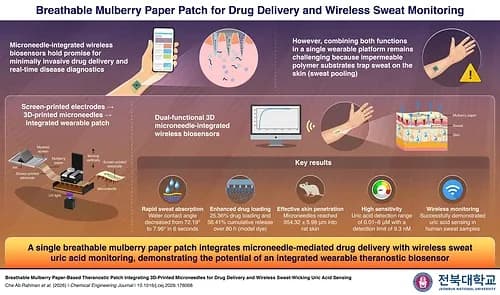
Researchers at Jeonbuk National University have developed a novel wearable patch using traditional Korean hanji paper, integrating 3D printed microneedles for drug delivery and electrodes for wireless uric acid monitoring. This patch could provide a non-invasive method for tracking uric acid levels in sweat, a key biomarker for conditions like gout.
Development of the Wearable Patch
A team from Jeonbuk National University (JBNU) has created a unique wearable patch utilizing traditional Korean mulberry paper, known as hanji. This patch incorporates 3D printed microneedles designed for drug delivery alongside printed electrodes that can wirelessly monitor uric acid levels in sweat, which is crucial for managing conditions such as gout and hyperuricemia.
Technical Features
The microneedles were produced using a light-based printing technique, adhering directly to the hanji without any adhesive. This innovative approach allowed the needles to hold approximately double the drug volume compared to conventional designs. The patch demonstrated an effective drug release, discharging over 56% of a model dye over 80 hours. Furthermore, it was able to penetrate rat skin to a depth of about 954 micrometers while maintaining its structural integrity.
Advantages of Hanji Over Plastic
The choice of hanji over plastic film is significant due to its ability to wick moisture away from the skin, preventing irritation and facilitating easier sweat sampling. This feature is essential for the patch's function, as polymer-backed patches can retain sweat against the skin, complicating accurate monitoring.

Promising Results for Uric Acid Monitoring
The electrochemical sensor within the patch can detect uric acid concentrations as low as 9.3 nanomolar, offering an alternative to traditional blood tests. Validation against laboratory methods showed high accuracy, recovering between 98.1% and 101.3% of known amounts in tests. The patch dried quickly and maintained consistent results across multiple measurements.
Future Research and Potential Applications
Currently, the patch's drug delivery and sensing functions have been tested independently. Future research aims to combine both functionalities during real-time trials while replacing model dyes with clinical drugs. This advancement could pave the way for a comprehensive solution that integrates health monitoring with therapeutic delivery, potentially transforming patient care for conditions related to uric acid levels.