
FDA Approves 3D Printed Titanium Cervical Implant by Providence Medical Technology
Written with artificial intelligence.
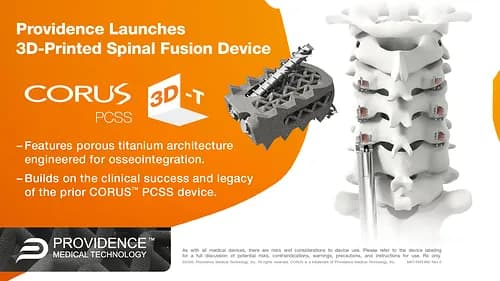
Providence Medical Technology has obtained FDA 510(k) clearance for its CORUS Posterior Cervical Stabilization System 3D-T, a next-generation cervical fusion implant made from porous titanium. The first commercial procedures using this device were successfully completed by surgeons in California and Virginia.
FDA Clearance for CORUS 3D-T
Providence Medical Technology has received 510(k) clearance from the U.S. Food and Drug Administration (FDA) for its CORUS Posterior Cervical Stabilization System 3D-T (CORUS PCSS 3D-T). This advanced cervical fusion implant, crafted from porous titanium using additive manufacturing, aims to improve spine stabilization for patients suffering from cervical degenerative disc disease. The initial commercial procedures were carried out by orthopedic spine surgeons Mohsin Fidai, MD, in Los Angeles and Abilio Reis, MD, in Virginia.
Features of the CORUS PCSS 3D-T
The CORUS PCSS 3D-T builds upon the established design of its predecessor while incorporating a proprietary titanium lattice that mimics the structure of cancellous bone. This design seeks to enhance bone ingrowth by optimizing pore sizes and porosity, which promotes better integration with the patient's bone. Bruce McCormack, MD, co-founder of Providence Medical Technology, emphasized the importance of the implant's interface with bone, stating that the new design offers 1.5 times the surface area and eight times the surface roughness of the original implant.
Clinical Validation and Comparison
The previous version of the implant, the CORUS PCSS, demonstrated promising results in a randomized clinical trial (NCT04229017), showing higher fusion rates and lower surgical revision rates when combined with anterior fusion techniques. However, Providence has yet to disclose comparable clinical outcomes for the new 3D printed version. Lane Major, President and CEO, noted that the CORUS PCSS 3D-T is built on a foundation of strong clinical evidence, now enhanced with the benefits of porous titanium.

Industry Context
This move by Providence reflects a broader trend in the medical device industry, where companies are increasingly utilizing 3D printing technology to enhance existing implant designs. Similar advancements were made by Centinel Spine in 2018 with their FLX Platform, which brought a new titanium lattice design to market while maintaining surgical familiarity for practitioners. The CORUS PCSS 3D-T, with its posterior surgical approach, distinguishes itself anatomically from other offerings in the market.
For ongoing updates in the field of 3D printing, interested parties can subscribe to relevant industry newsletters or follow major companies on social media.