
Creatz3D Delivers Locally Produced Ceramic Lift Pins to Semiconductor Foundry in Singapore
Written with artificial intelligence.
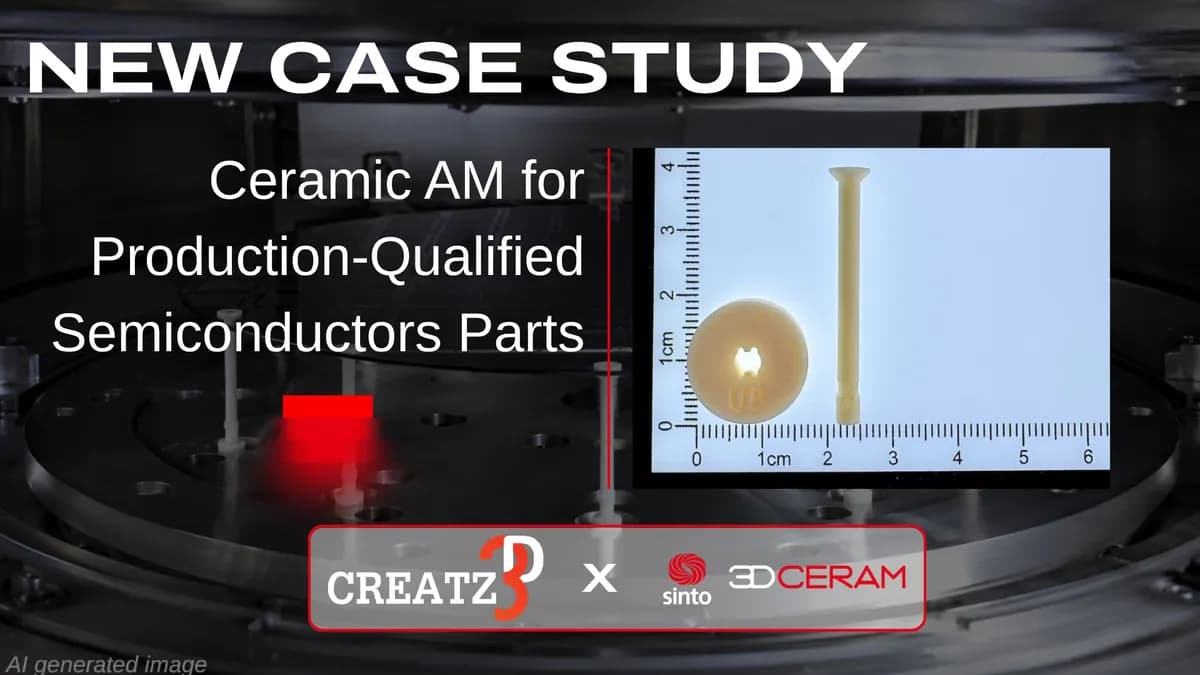
Creatz3D, a Singapore-based additive manufacturing company, has successfully delivered 600 sets of 3D printed alumina lift pins to a global semiconductor foundry. This achievement, facilitated by ceramic additive manufacturing technology from 3DCERAM SINTO, underscores the speed and efficiency of local production, reducing supply chain dependencies.
Local Production of Ceramic Components
Creatz3D has completed the delivery of 600 sets of 3D printed alumina lift pins to a prominent semiconductor foundry in Singapore. These components have received full production qualification for use in chemical vapor deposition (CVD) chambers, marking a significant milestone in local additive manufacturing capabilities.
The production cycle, which included printing, debinding, sintering, and post-processing, was achieved within six weeks. Each lift pin measures approximately 6.5 mm in diameter and 40 mm in height, with a base measuring about 20 mm in diameter and 4 mm in height. This rapid turnaround allowed the foundry to maintain continuous production, significantly reducing lead times and reliance on overseas suppliers.
Benefits of Ceramic Additive Manufacturing
The lift pins are designed to support and precisely position silicon wafers during semiconductor processing, operating in environments that require exceptional dimensional stability and wear resistance. The use of alumina (Al₂O₃) was chosen for its high mechanical strength and electrical insulation properties. By utilizing ceramic additive manufacturing, Creatz3D produced these components to meet strict dimensional tolerances.
Creatz3D and 3DCERAM SINTO highlight four main advantages of this production method:
- Supply Chain Resilience: Local production minimizes dependency on overseas sourcing.
- Shorter Lead Times: Transitioning from design to qualified production occurs in weeks.
- Cost Efficiency: Lower total costs for complex parts.
- Repeatable Production: Demonstrated by the validated delivery of 600 sets.
Collaboration and Future Prospects
The collaboration between 3DCERAM SINTO and Creatz3D, which began in 2016, aims to bridge the gap between prototyping and qualified production in the ceramic additive manufacturing space. This partnership underscores a growing trend in the industry, where local production capabilities are essential for meeting the demands of sectors like semiconductors.
As ceramic additive manufacturing continues to evolve, the focus on qualification processes will play a crucial role in the adoption of new materials and technologies. The successful delivery of these lift pins indicates promising advancements in the field, paving the way for further innovations in local manufacturing.