
Research Achieves Record Tensile Strength in 3D Printed Silica Glass
Written with artificial intelligence.
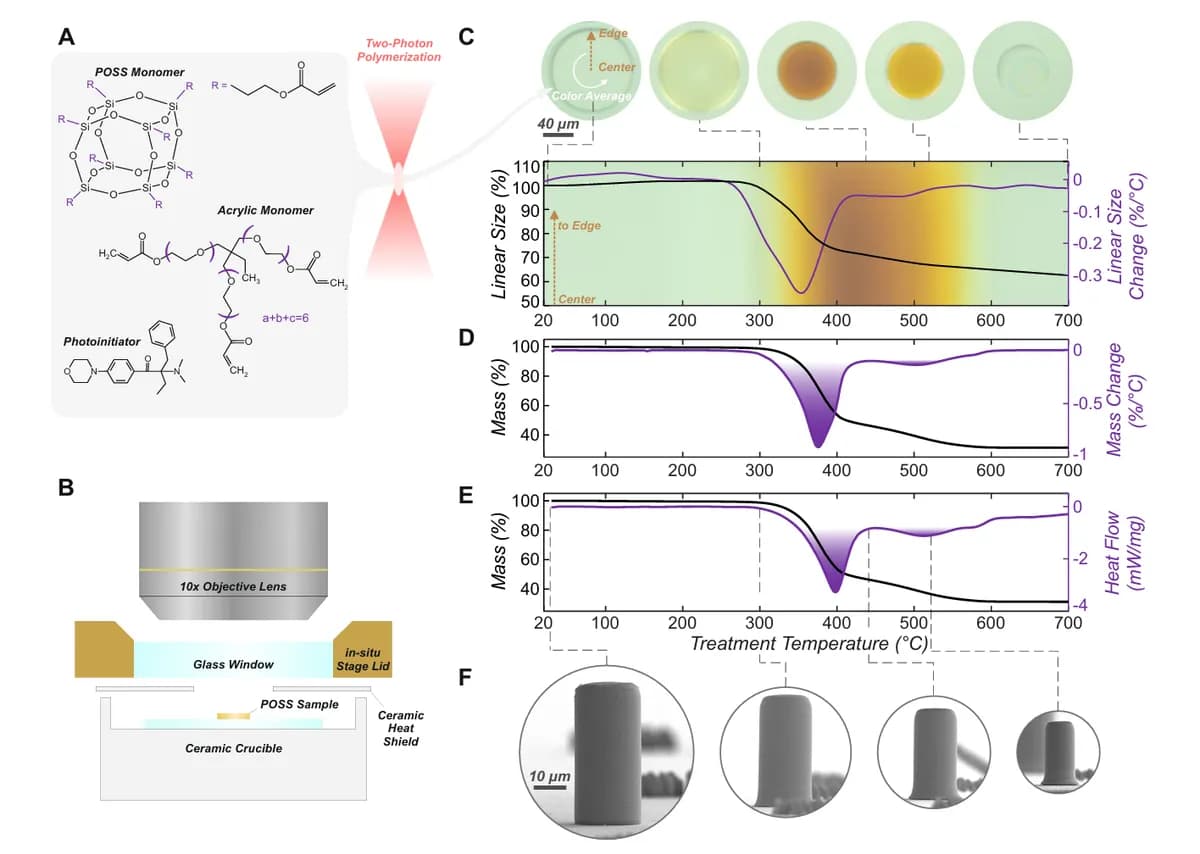
Researchers at the Karlsruhe Institute of Technology (KIT) have developed a method to 3D nanoprint silica glass, achieving a record tensile strength of 5.94 GPa. Their study details the transformation from a hybrid polymer to glass during heat treatment, providing insights into the material's internal changes.
Groundbreaking 3D Printing of Silica Glass
Researchers from the Karlsruhe Institute of Technology (KIT) have successfully 3D nanoprinted silica glass using two-photon polymerization (2PP), achieving an impressive tensile strength of 5.94 GPa. This advancement, documented in their study published in Communications Materials, highlights the process by which a hybrid polymer transforms into glass when subjected to heat treatment.
Methodology and Findings
The team utilized a resin based on polyhedral oligomeric silsesquioxane (POSS) combined with other components to create the printing material. Disks measuring 100 µm were printed and subsequently heated, revealing significant changes in size, color, and mass. The results showed that at around 300°C, the material began to yellow and shrink, while at temperatures exceeding 600°C, a stable silica structure emerged, marking a transition to brittleness. Notably, the tensile strength increased significantly as the temperature rose, reaching values that surpass those of conventional glass fibers.
Implications for Future Applications
The study emphasizes the importance of forming a self-supporting inorganic network during the conversion process, which is critical for maintaining the structural integrity of the printed parts. This research may pave the way for new applications in microsystems, particularly those that require temperature-sensitive components. The ability to control the properties of the material through precise heat treatment opens up possibilities for a broader range of materials in 3D printing.
Addressing Knowledge Gaps
While previous research focused on the final product of heat treatment, the KIT study offers valuable insights into the internal structural changes throughout the process. This knowledge could enhance the understanding and application of 2PP in the production of glass-based materials, potentially leading to advancements in various industries.
The research was conducted by Jiajie Liang, Lisa Hoffmann, Paul Albrecht, and Jens Bauer, contributing significantly to the field of additive manufacturing.