
Providence Medical Technology Secures FDA Clearance for New 3D Printed Cervical Fusion Implant
Written with artificial intelligence.
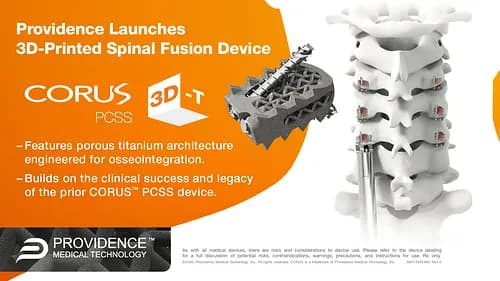
Providence Medical Technology has achieved 510(k) clearance from the FDA for its CORUS Posterior Cervical Stabilization System 3D-T, a novel cervical fusion implant made from porous titanium. Initial commercial surgeries have already been performed in California and Virginia, indicating a significant step forward in spinal surgery technology.
FDA Clearance for Innovative Implant
Providence Medical Technology has received 510(k) clearance from the U.S. Food and Drug Administration (FDA) for its CORUS Posterior Cervical Stabilization System 3D-T (CORUS PCSS 3D-T). This next-generation implant, designed for posterior cervical fusion (PCF), is produced using porous titanium through additive manufacturing (AM). Surgeons have already performed the first commercial procedures using this device in California and Virginia.
Enhanced Design Features
The CORUS PCSS 3D-T is specifically indicated to stabilize spinal segments in patients with cervical degenerative disc disease. The implant incorporates a proprietary titanium lattice structure, modeled after cancellous bone, which enhances bone ingrowth. This new design offers 1.5 times the surface area and eight times the surface roughness compared to its predecessor, allowing better integration with the bone during the healing process.
Dr. Bruce McCormack, Co-Founder of Providence Medical Technology, emphasized the importance of the bone-implant interface in posterior cervical fusion, stating that the porous lattice design facilitates improved bone growth into the implant.

Clinical Background and Future Prospects
The previous version of the implant, CORUS PCSS, demonstrated positive outcomes in a randomized clinical trial, showing higher fusion rates when paired with multilevel anterior fusion. However, comparable clinical data for the 3D printed version has not yet been reported.
The first surgeries using the CORUS PCSS 3D-T were conducted by orthopedic spine surgeons Mohsin Fidai, MD, at Adventist Health White Memorial in Los Angeles, and Abilio Reis, MD, at Bon Secours Memorial Regional Medical Center in Virginia.
Conclusion
Providence Medical Technology's innovative approach to spinal implants represents a significant advancement in the field. By leveraging existing design principles and enhancing them with 3D printing technology, the company aims to improve surgical outcomes and patient recovery in cervical fusion procedures.