
Evaluation of the First Fully 3D-Printed 5-mm Laparoscopic Grasper for Training
Written with artificial intelligence.
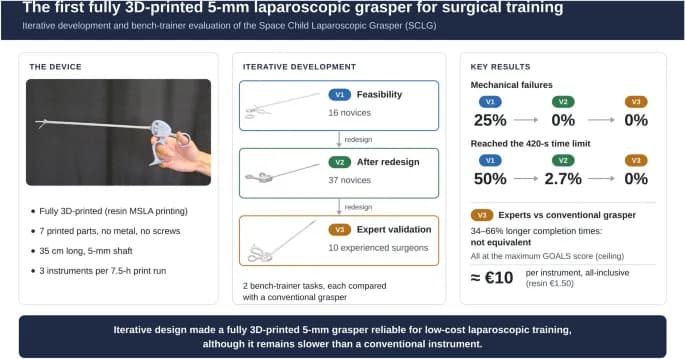
The Space Child Laparoscopic Grasper (SCLG) is the first fully 3D-printed 5-mm laparoscopic instrument, designed to enhance surgical training in resource-limited settings. Initial evaluations indicated improvements in reliability and performance, with a production cost of approximately €10 per instrument.
Introduction
Laparoscopic skills are essential for modern surgical practices, but the high cost of traditional instruments and simulators often limits access, especially in resource-constrained environments. To address this challenge, the Space Child Laparoscopic Grasper (SCLG) was developed as a fully 3D-printed training tool that maintains standard clinical dimensions.
Development Process
Designed using Fusion 360, the SCLG was created from a single photopolymer resin through masked stereolithography. Over twenty prototypes were produced, undergoing multiple design-test-redesign iterations to refine performance. Three phases of bench-trainer evaluations were conducted, comparing the SCLG to conventional graspers across tasks such as elastic band transfer and peg transfer involving novices and experienced surgeons.
Results
The initial version (V1) exhibited a 25% mechanical failure rate, with 50% of novices failing to complete tasks within the time limit. After redesign (V2), mechanical failures were eliminated, and only 2.7% of novices reached the time limit. Expert validation (V3) showed no failures, but completion times for the SCLG remained longer than for conventional graspers, indicating that while the SCLG is feasible for training, it is not yet equivalent in performance. The production cost was around €10 per instrument, including €1.50 for resin.
Conclusion
The SCLG demonstrates the potential for fully 3D-printed laparoscopic graspers in simulation-based training. Continuous design optimization has significantly improved its reliability and performance, making it a valuable tool despite not matching the efficiency of traditional instruments. Its low cost and reproducibility suggest it could enhance surgical training opportunities, particularly in underserved areas.