
Advancements in 3D-Printed Materials for Real-Time Damage Detection
Written with artificial intelligence.
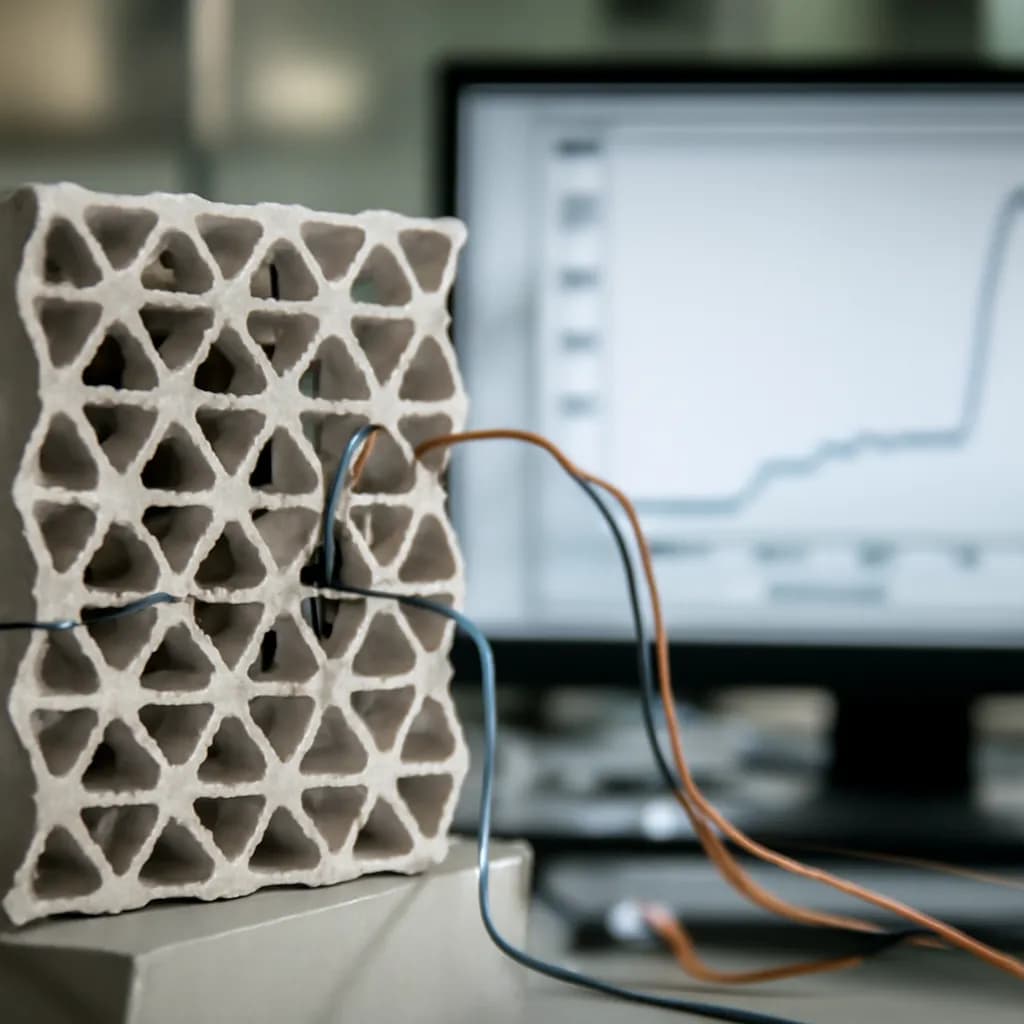
A collaborative research effort has led to the development of 3D-printed materials capable of sensing damage and tracking its progression in real time. This innovation, which combines carbon nanotubes with advanced imaging techniques, could significantly enhance the durability and safety of materials used in various applications, including medical and aerospace fields.
New Research Overview
An international team of engineers has successfully adapted a medical imaging technique to enable 3D-printed materials to detect and monitor damage in real time. This research, spearheaded by academics from the UK and Australia, paves the way for the creation of 'self-sensing' metamaterials designed for optimal characteristics such as strength, flexibility, and impact resistance.
Innovative Approach
The innovative technique involves incorporating carbon nanotubes into 3D-printed plastic structures that feature intricate lattice designs. By applying electrical current through these nanotubes using external electrodes, the researchers utilized electrical impedance tomography (EIT) to assess the structural integrity of the materials as they were subjected to stress. This marks the first known application of in situ EIT for monitoring damage in architectured metamaterials.
Real-Time Monitoring Capabilities
EIT, commonly employed in medical diagnostics, allows for non-invasive observation of internal changes in materials. In this study, the team successfully mapped variations in electrical conductivity within the 3D-printed structures as they were tested to failure. The EIT method can detect damage even in areas distant from the electrodes, providing a comprehensive view of structural health.

Future Applications
The findings open up possibilities for various applications, especially in medical implants, aircraft components, and automotive parts. The research demonstrates potential for early-warning systems that could forecast structural failures by identifying damage before it leads to catastrophic failure. Although promising, further development is needed to translate these findings into practical applications.
The research paper, titled ‘Full-Field Damage Monitoring in Architected Lattices Using In situ Electrical Impedance Tomography’, is published in Advanced Functional Materials. Support for the study came from the University of Sydney–University of Glasgow Ignition Grants and a Vaibhav Fellowship awarded to Professor Shanmugam Kumar by the Indian National Academy of Engineering.