
3D Printed Lattices Detect Damage Before Failure
Written with artificial intelligence.
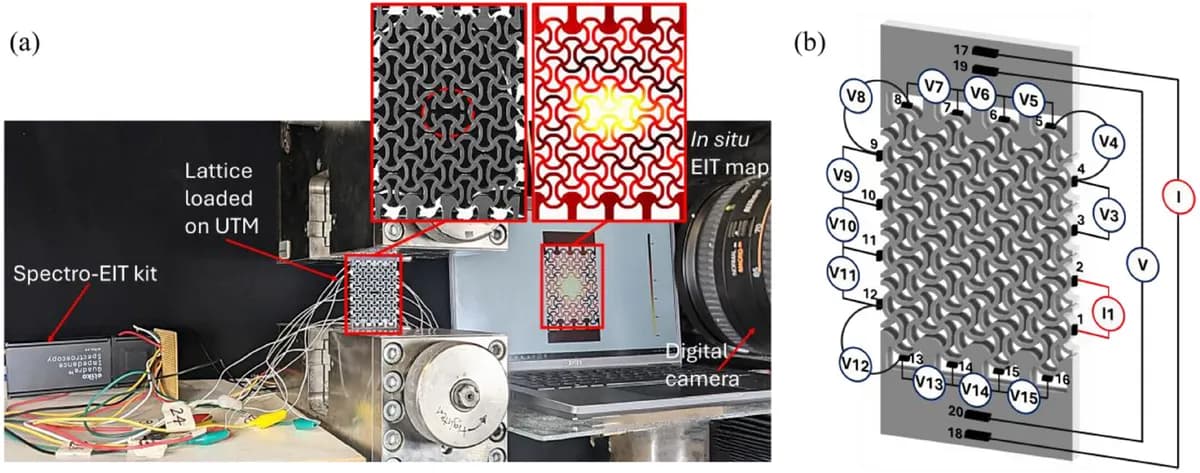
A recent study highlights the potential of 3D printed lattices for early damage detection in critical applications, such as aviation. By utilizing Electrical Impedance Tomography (EIT), researchers have created a method that allows real-time monitoring of structural integrity.
Innovative Damage Monitoring in Lattices
A new research paper titled "Full-Field Damage Monitoring in Architected Lattices Using In situ Electrical Impedance Tomography" reveals a significant advancement in damage detection using 3D printed lattices. The study emphasizes how these engineered structures can improve safety in critical sectors, particularly aviation, by enabling the detection and prediction of damage as it occurs.
The Role of Electrical Impedance Tomography (EIT)
Researchers employed Electrical Impedance Tomography (EIT), a non-contact method traditionally used in medical and industrial applications, to monitor the structural integrity of 3D printed Voronoi lattices. By placing electrodes strategically, they measure changes in electrical conductivity, producing a detailed 3D map of the lattice's condition. This technique can identify damage long before a structural failure, offering a proactive approach to maintenance.
Key Findings and Applications

The study, conducted at the University of Glasgow's Sustainable Multifunctional Materials and Additive Manufacturing Lab, demonstrated that the carbon nanotube-doped lattices could reveal damage through conductivity loss. Different lattice topologies showed varying levels of effectiveness in damage detection. The researchers aim to develop systems that lead to self-sensing materials capable of alerting users to structural issues in real time.
Future Implications
This innovative approach could revolutionize safety monitoring in various fields, including aerospace and marine engineering. By facilitating quick and cost-effective testing, it holds promise for enhancing the reliability of 3D printed components such as valves and aircraft parts. As the technology matures, it may be possible to implement live monitoring in high-stakes environments like ship engines and rocket systems, significantly improving safety measures in these industries.